I love walking around Genoa. No matter how often I go, there is always something to see and discover. On one such walk I happened to be with my Italian friend Anna, whose knowledge of the history of the city is phenomenal. We were walking on a stone pavement in the city centre, when Anna stopped and started looking for something on the street. She asked:
"Did you know that hundred years ago, all these stone slabs were hand crafted by stone masons who then also decorated and signed them?"
So we are not walking on any old concrete slabs then?
I started looking at the pavement with a newly found curiosity.
Sure enough we found one such signature (pic above), hidden away in of the stones in a pavement leading to an alley. It was quite a revelation to realise that hundred years ago the pavement stones were not manufactured in some nameless factory, which produced thousands such slabs a day, but that every single one was painstakingly patiently made by stone masons who decorated every stone in their own style and treated this as an opportunity to leave their own mark in Genoa. Those stones have lasted to this day - respect!
Showing posts with label centro storico. Show all posts
Friday, 16 January 2015
Thursday, 7 November 2013
GINGER ICE CREAM? WE GOT IT!
It may be November and the winter is approaching fast, but ice cream is still firmly on the menu for the Italians. There are numerous gelato bars in Genoa alone and come a sunny day, there might even be queues outside the best ones regardless of the time of year.
One particularly popular ice cream shop in town, U Gelato du Caruggiu, on Via San Bernardo #91 in the centro storico, is a magnet for gelato connoisseurs looking for unusual flavours.
| Moreno and Barbara make approximately 25 different ice creams every day. |
Yesterday I went together with other members of the American International Women's Club of Genoa (AIWC) to learn how the owners Moreno and Barbara, a husband and wife team, transform such humble ingredients as milk, butter and eggs into an ice cream base where different flavourings are then added afterwards. We were able observe the process through a glass window while Moreno explained the technical details. He stressed how important it is to get the balance of the ingredients right. Be aware, that if your ice cream starts melting the minute you get the cone in your hands, it has not been made correctly.
| Chesnut and rosemary make an interesting change from the normal "vanilla-strawberry-chocolate" choice.
|
| Barbara with the very delicately flavoured icecream: violet. |
We were given small samples to taste of all the flavours and my absolute favourite is ginger, quite a sharp and spicy ice cream with lots of character. Regular customers are also raving about zabaglione, cinnamon, ciocco frizzy and hazelnut icecream (nocciola)....
Monday, 4 November 2013
A MOMENT OF PEACE WITH MUSIC
I recently walked in the area of Piazza Banchi in the centro storico. I have passed this place quite a few times while exploring the city, but not noticed that there is a tiny church, elevated on top of the shops. The doors were open, so I went in. It happened to be a bit of a grey autumn day, around noon.
As soon as I stepped inside the Chiesa di S Pietro I heard beautiful classical music and quite a familiar tune too. I have heard this piece before but could not remember the composer. It really did not matter. I soon felt totally at peace with myself and the rest of the world. Far away was the huzzle and buzzle of the street and the city.
| Piazza Banchi and Chiesa di S Pietro. |
Curios about the history of this place, I picked up a leaflet in English at the entrance, where it was explained that the church was built during the second half of the 16th century on the ruins of another church. The original church was destroyed by fire. The architects, Taddeo Cartone and Daniello Caselle, modelled this new church on Basilica Assunta in Carignano.
| There are beautiful frescoes just outside the entrance, up on the ceiling. |
Thursday, 8 August 2013
PILLARS OF SHAME
Everyone has heard about monuments built in honor of something or somebody. But the Genovese have gone one step further: in this city there are monuments in order to remember something that is shameful or disgraceful. There are at least two pillars of shame (colonna infame) in the city centre. My friend Mary took me to see one of them and it has actually been put there to shame the city of Genoa itself.
| This pillar of shame can be found very close to Museo di Sant'Agostino in Piazza di Sarzano. |
This particular pillar is a reminder of the fact that when the city of Genoa decided to re-built a specific part of the historical centre, they destroyed a whole neighbourhood in the process, including the birth place of violonist Niccolo Paganini. Even though a new house has been built nearby to mark Paganini's birth place, it is not quite the same say those who would have preferred to visit the original one.
Friday, 24 May 2013
ROUGH EDGES
Yesterday I was walking in an area in centro storico, better known as Maddalena.
This is a particularly lively part of town, practically in the backyard of Via Garibaldi, one of the main tourism attractions. It is full of character with quirky little shops selling vintage clothes, bags and shoes (not necessarily cheap) and food shops with special pasta and olive oil to die for (try olioteca Le Gramole on Via dei Macelli di Soziglia). Being a small and compact place, a casual stroll will soon lead to a particularly noteworthy church, the Santa Maria Maddalena, which is actually an active parish with a community feel, and not just a museum piece. I was on my way to another landmark in the area, Palazzo Spinola, which does not look much from the outside but is rich in velvet, silk, antique furniture and paintings inside. The real depth of this area can only be appreciated with repeated visits as something new always catches the eye.
But it does not take long before something else registers too: the number of prostitutes along the narrow alleyways. Groups of quite young looking girls stand idly in the street corners, in dresses, which would not look out of place in a disco or a nightclub, but are a slightly comical choice of clothes to wear in the full afternoon sun. Stylish jeans teamed up with generously open t-shirts,loud lipstick, smoky eyes and lots of mock gold jewellery were giving the same message to any passer-by. Loud popmusic was coming out of one open window. These streets may not be a pleasant place to be during the night time, but I was not feeling particularly threatened as it was only 4 PM, full day light and plenty of people around. I was surprised though to see so many girls, chatting or catching a dance step or two.
Prostitution is legal in Italy, but establising a brothel or pimping is not. There are many sad stories of human trafficking and violence against women, drugs and desperation. In the Maddalena area, the local shopkeepers are not happy about having such an open display of a different kind of trade on their door step as potential customers for other than sex are inclined to take a quick shortcut to a safer looking side of town as soon as they see the girls. Neighbourhood action groups are trying to find a solution to the problem. For the time being the shopkeepers and the girls are forced to tolerate each other. It is an uneasy relationship.
Monday, 13 May 2013
GENOA THROUGH THE CAMERA LENSE
I had an amazing weekend - a 2 day photography course with Di Mackey (www.dimackeyphotography.com) in Genoa. Di lives in Belgium, but has been coming to Genoa since 2008. She organises photography courses and workshops especially here as she loves the city and wants to return to Genoa time and time again.
I have been firmly in the group of snappers, who mainly trust the automatic functions and - I am ashamed to admit - have barely given the camera manual a casual glance, if that. But I have felt for some time that it would be interesting to learn more, getter better pics and understand the science behind it, hence the course with Di.
During the weekend Di and I walked around the city, especially in the centro storico area, where it is always easy to find something new, an intriguing detail or a landscape where beauty is often combined with rough edges. When you walk around with your camera ready, even frequently visited places start looking different and inspiring.
Take Palazzo Ducale, for example, which is one of the first landmarks anyone visiting Genoa learns to recognise. This is a buzzing cultural centre with museums and cafes, but also a place where people come to walk in the beautiful atrium, seeking shade during the hot summer months, listen to music or participate in a debate. Often these events are free or there is a small entrance fee.
Inside the Palazzo, there is currently an unusual installation called "Timeology" by Lorenzo Petrantoni, a graphic designer and an artist, who uses historical images to tell a story.
| These pillars have been transformed into vessels for an art installation. |
This time Petrantoni's collection of black and white images are on the pillars, full of fascinating details, collage of images. They come alive on closer inspection. Playful and fun, these images are of people and events from Genoa's historical past.
Petrantoni was born in Genoa in 1970, studied graphic design in Milan, then moved to France to work there. But after returning to Italy, he wanted to take a break from the advertising world and started to concentrate on his own art instead.
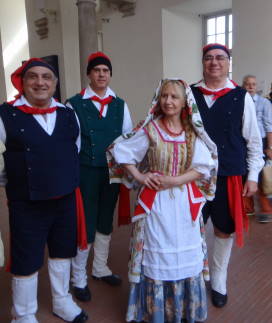
When we came back later in the afternoon to Palazzo Ducale, we noticed that there was clearly a free concert on offer. A Campagna, a folk music group with musicians, singers and dancers, performed traditional songs and dances from Genoa. They sing in genovese, the local dialect, which is difficult to master unless taught by someone who has used it on regular basis. Even native Italian speakers struggle to understand this dialect.
| Members of A Campagna group in their traditional costumes. |
Most people in Genoa know some words in genovese, but less and less people can actually speak the language anymore. In the past, perhaps a century ago, genovese was actively used in all verbal communication. People were even able to tell which part of the city someone comes from based on their accent or some words they used. A Campagna is dedicated to keep the language alive.
| Genoa is full of free events. Take your seat and enjoy! However, especially with concerts, it is customary to give a small donation afterwards as a token of appreciation. |
Subscribe to:
Posts (Atom)