Friday, 24 May 2013

ROUGH EDGES

Yesterday I was walking in an area in centro storico, better known as Maddalena.
This is a particularly lively part of town, practically in the backyard of Via Garibaldi, one of the main tourism attractions. It is full of character with  quirky little shops selling vintage clothes, bags and shoes (not necessarily cheap) and food shops with special pasta and olive oil to die for (try olioteca Le Gramole on Via dei Macelli di Soziglia).  Being a small and compact place, a casual stroll will soon lead to a particularly noteworthy church, the Santa Maria Maddalena, which is actually an active parish with a community feel, and not just a museum piece. I was on my way to another landmark in the area, Palazzo Spinola,  which does not look much from the outside but is rich in velvet, silk, antique furniture and paintings inside. The real depth of this area can only be appreciated with repeated visits as something new always catches the eye.
    But it does not take long before something else registers too: the number of prostitutes along the narrow alleyways. Groups of quite young looking girls stand idly in the street corners, in dresses, which would not look out of place in a disco or a nightclub, but are a slightly comical choice of clothes to wear in the full afternoon sun. Stylish jeans teamed up with generously open t-shirts,loud lipstick, smoky eyes and lots of mock gold jewellery were giving the same message to any passer-by. Loud popmusic was coming out of one open window. These streets may not be a pleasant place to be during the night time, but I was not feeling particularly threatened as it was only 4 PM, full day light and plenty of people around. I was surprised though to see so many girls, chatting or catching a dance step or two.
  Prostitution is legal in Italy, but establising a brothel or pimping is not. There are many sad stories of human trafficking and violence against women, drugs and desperation. In the Maddalena area, the local shopkeepers are not happy about having such an open display of a different kind of trade on their door step as potential customers for other than sex are inclined to take a quick shortcut to a safer looking side of town as soon as they see the girls. Neighbourhood action groups are trying to find a solution to the problem. For the time being the shopkeepers and the girls are forced to tolerate each other. It is an uneasy relationship.

Monday, 13 May 2013

GENOA THROUGH THE CAMERA LENSE

I had an amazing weekend - a 2 day photography course with Di Mackey (www.dimackeyphotography.com) in Genoa. Di lives in Belgium, but has been coming to Genoa since 2008. She organises photography courses and workshops especially here as she loves the city and wants to return to Genoa time and time again. 
   I have been firmly in the group of snappers, who mainly trust the automatic functions and - I am ashamed to admit - have barely given the camera manual a casual glance, if that. But I have felt for some time that it would be interesting to learn more, getter better pics and understand the science behind it, hence the course with Di.
  During the weekend Di and I walked around the city, especially in the centro storico area, where it is always easy to find something new, an intriguing detail or a landscape where beauty is often combined with rough edges. When you walk around with your camera ready, even frequently visited places start looking different and inspiring.

   Take Palazzo Ducale, for example, which is one of the first landmarks anyone visiting Genoa learns to recognise. This is a buzzing cultural centre with museums and cafes, but also a place where people come to walk in the beautiful atrium, seeking shade during the hot summer months, listen to music or participate in a debate. Often these events are free or there is a small entrance fee.
Inside the Palazzo, there is currently an unusual installation called "Timeology" by Lorenzo Petrantoni, a graphic designer and an artist, who uses historical images to tell a story.


These pillars have been transformed into vessels for an art installation.
  This time Petrantoni's  collection of black and white images are on the pillars, full of fascinating details, collage of images. They come alive on closer inspection. Playful and fun, these images are of people and events from Genoa's historical past.
Petrantoni was born in Genoa in 1970, studied graphic design in Milan, then moved to France to work there. But after returning to Italy, he wanted to take a break from the advertising world and started to concentrate on his own art instead. 


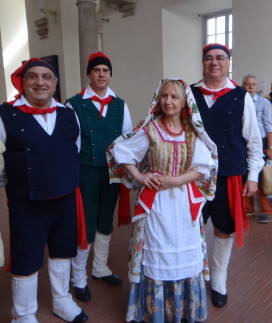
When we came back later in the afternoon to Palazzo Ducale, we noticed that there was clearly a free concert on offer. A Campagna, a folk music group with musicians, singers and dancers, performed traditional songs and dances from Genoa. They sing in genovese, the local dialect, which is difficult to master unless taught by someone who has used it on regular basis. Even native Italian speakers struggle to understand this dialect.

Members of A Campagna group in their traditional costumes.


 Most people in Genoa know some words in genovese, but less and less people can actually speak the language anymore.  In the past, perhaps a century ago, genovese was actively used in all verbal communication. People were even able to tell which part of the city someone comes from based on their accent or some words they used. A Campagna is dedicated to keep the language alive.

Genoa is full of free events. Take your seat and enjoy! However, especially with concerts, it is customary to give a small donation afterwards as a token of appreciation.

Friday, 10 May 2013

A TERRIBLE TRAGEDY LEAVES GENOA SHOCKED

The city of Genoa is in mourning. Late in the evening on Tuesday night nine people lost their lives and others were seriously injured  in a freak accident when a container ship hit the control tower in the port of Genoa.
  As has now been reported all over the world, the Jolly Nero was leaving for Naples, in perfect weather conditions, assisted by tug boats with pilots, when for reasons unknown the ship took a wrong turn and crashed into the tower. At least 13 people are known to have been in the tower, as one shift of pilots were leaving home, letting their colleagues to take over. On impact the 40 meter long tower - made of concrete and glass -  collapsed totally and an ordinary, uneventful night turned into a scene from hell.
  Naturally, there has been a massive coverage on the accident in Italian newspapers with countless theories, speculation and opinions on what might have gone wrong. Was it a mechanical fault or a human error? We will not know until the official investigation has been completed and that will take a long time. The commander of the ship and the pilot, who was assisting him, have testified that the ship's steering mechanism did not respond and that it was out of control.
  Genoa is a small place. The people who died in this accident were between 30 and 50 years old, one of them was a woman. Many of the victims were married with children and they were all well known in their communities. Pilots are an especially tight-knit group in Genoa. Everyone is beside themselves with grief, having lost close friends and relatives in the accident.
   However, one 36-year old man, currently recovering in a hospital with a broken arm and bruises, had an absolutely miraculous escape. He was interviewed yesterday by the local newspaper, Il Secolo XIX.
  The man had just finished his shift around 11 PM and he went into a lift in the tower with two other colleagues. Suddenly, all hell broke loose: the lift started to shake and rattle, "like in an earthquake." The man said that he did not understand what was happening. The lift seems to have flown up in the air, landing into the sea. It started sinking rapidly.  The man - still inside the lift and conscious - said that everything was dark around him and the water was freezing cold. He managed to find a gap in the wreckage and got out through this small hole. When he got up to the surface, after swallowing sea water and gasping for air, he was totally disorientated and did not even realise that his arm was broken.  Luckily, he found something to hold on and he calmed down while thinking about his pregnant wife.  "This is not the way I want to die", he remembers saying to himself, watching ambulances and flashing sirens on the shore. Finally, he was  found by rescuers who pulled him into a boat and took him to the hospital. He certainly has every reason to be thankful.


Sunday, 5 May 2013

FOR THE LOVE OF JAZZ

There is one museum in Genoa, bang in the city centre, next to Palazzo Ducale, which you might never even notice unless you knew that it is there: the Museo del Jazz.
   I have wanted to visit this place for a long time, but this turned out to be a bit of a mission. I knew that it is open only for couple of hours in the afternoon, but the first time I went the museum was clearly closed and I could not even see, where the entrance might be on Via Tommaso Reggio. There was no signs of the museum even existing in that place. It was a Monday, which is typically not a good day to visit any museums, but I read from somewhere that it might be open - well, it wasn't. But last week I got lucky. The very heavy doors were open, just a fraction. There was a notice in italian that the Museum is open from Tuesdays to Fridays from 5 PM to 7 PM. Bingo!

The Museo del Jazz is just next to Palazzo Ducale, the entrance is on a side street, Via Tommaso Reggio.

The glass door was closed, so I rang the bell. A very friendly, elderly Italian gentleman came to open and let me in. It was immediately clear that this is not a musem in the traditional sense and the gentleman confirmed this to be the case. It is more of an archive where jazz fans can come to listen their favourites or find recordings by a particular artist or an era in jazz, which they want to explore more. It is an amazing place and very clearly run by people who are passionate about jazz.
  The musem, which was founded in 2000,  houses over  10 000 pieces - records, CDs, cassette tapes and videos -  and the collection includes most of  the recordings ever made by Duke Ellington, Louis Armstrong, Billie Holliday and other jazz royalty. The museum also organises jazz related gatherings such as lectures of a particular artist/era/style of jazz. And if you want to learn how to play jazz, there is a music school where you could learn how to sing jazz or play sax, clarinet or other instruments. More information (all in italian) can be found from their website - www.italianjazzinstitute.com.
This sign for Lousiana Jazz Club is displayed right next to Palazzo Ducale, but the club is actually located elsewhere in the city, on Via San Sebastiano.
  The museum is attached to the Louisiana Jazz Club, which has been the centre of jazz in Genoa since 1964 and if you want to get to know the jazz scene in Genoa,  that is the place to be on most Thursday evenings (Via San Sebastiano 36). However, it is wise to check in advance on their website (www.louisianajazzclub.com), if there is anything going on. A membership card currently costs 30 euro and it is valid for the whole calendar year, giving access to all concerts at the club. 
 Heaven!


Sunday, 28 April 2013

THE SUMMER IS HERE AND A POTTED GARDEN TOO

We have had gloriously sunny, warm days in the past couple of weeks and it is safe to declare that the summer has arrived! Even though the weather is still a bit patchy with some rain every now and then, it is not too bad at all. I went for a long walk along the coastal road from Nervi to Quarto one day last week and almost on every single little beach along the way, there were ladies sunbathing in bikinis and families with children playing on the edge of the water. In the city centre of Genoa, tourists have definitely arrived too. The sightseeing buses have started to operate again after the long winter months.
 
We have been waiting for the summer to begin for another reason too.
 
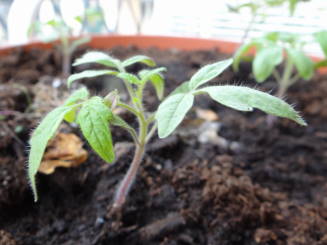
A short cold spell did not shock this little cherry tomato seedling too much.
John has taken the opportunity to establish a potted garden on the covered balcony area. He has bought countless packets of seeds (basil, spring onion, chilli, tomato, eggplant...) and lots of compost & soil from the garden shop nearby. We have also invested a small fortune in all kinds of pots.


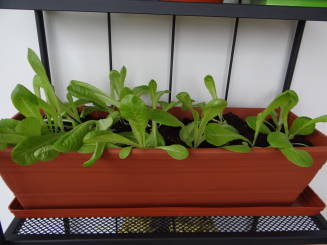
It has been quite a lot of fun to see how the tiny, tiny seedlings have pushed their way through, reaching for the sun.


The same herbs, salad  and cherry tomatoes are naturally available in the nearest grocery shop 200 metres away with fraction of the price it takes to get the seedlings to grow and survive, but it would not be as much fun to buy a very healthy looking bunch of basil at €1 per small pot... would it?

Friday, 22 March 2013

WHEN THE POST GOES MISSING

A friend decided to send me a cookery book from Finland as a present and I was really looking forward to getting it. I knew when she had mailed it, so it was just question of waiting for couple of days. But when I finally went downstairs to check the post, I was suprised to find a small box torn to pieces in the rubbish bin nearby. It had my name and address on it, but no book... 
  Since then, I have heard several stories from friends about parcels and letters which have never arrived through mail. It is not always safe to send anything from Italy to abroad either. If mail is sent to an office address, the chances of it disappearing are greatly reduced, I have been told. It is also wise to send any official, important letters by registered mail. At least you have proof that you sent it!

Thursday, 21 March 2013

AUCTION ITALIAN STYLE

Just a few minutes walk downhill from Piazza de Ferrari, in Vico Falmonica, is Cafe Cambi. Step inside and be ready for a pleasant surprise: heavy crystal chandeliers and very skillfully restored frescoes by Bernardo Strozzi from 1618, are instant reminders of a grand past of this magnificent building. Waiters in white crispy uniforms serve customers with trays full of coffee and cakes. As a visitor to Genoa, you could simply sit there, have a break and admire the historical surroundings. But there is more, much more, to this oasis in the heart of centro storico.
   The cafe is owned by the Cambi family and in the same complex is the town office the family business, Cambi Auction House, famous in Genoa. Here prospective sellers might come to meet the auctioneers and discuss some pressing business matters, such as to negotiate a sale of the contents of a family villa full of antique furniture, fine art and hand made carpets from the Orient.
   The Cambi Auction house was founded in 1998 by two brothers, Matteo and Sebastian Cambi. Two other brothers, Marcello - who is said to be the engine and soul of the whole family - and Giulio, are also very actively involved with the auction house.  A new branch was opened in Milan last year. There are 15 experts specialising in arts, design, clocks, books, oriental art and furniture.
This is just an example of items which were for sale in a recent auction held in March.
   The actual auctions happen in Castello MacKenzie, which is one of the architectually most interesting historical places in Genoa. The Cambi family bought this national monument in 2002 and it is now the headquarters of the auction house.
    The Castello was originally built between 1893 and 1905 when a Scottish insurer Evan MacKenzie commissioned a young and relatively unknown Italian architect from Florence, Gino Coppede to design it. Castello MacKenzie is open to the general public on auction days and it is possible to have a tour around the castle. It is worth reading the whole and fascinating story from the auction house's website www.cambiaste.com.
  Italian auction houses may not be as well known as Christie's and Sotheby's in London, but come to an international auction, such as the of Oriental Art auction in June last year, and you realise that Genoa might well be the place for something extraordinary and special. During that particular auction, Cambi sold an 18th century gilded and painted bronze from China for 597000 euro, a record at that time. The estimate was 20 000 - 25 000 euro.
   This year there are plenty of auctions to choose from and even if you end up buying nothing, Castello MacKenzie is certainly worth a trip.